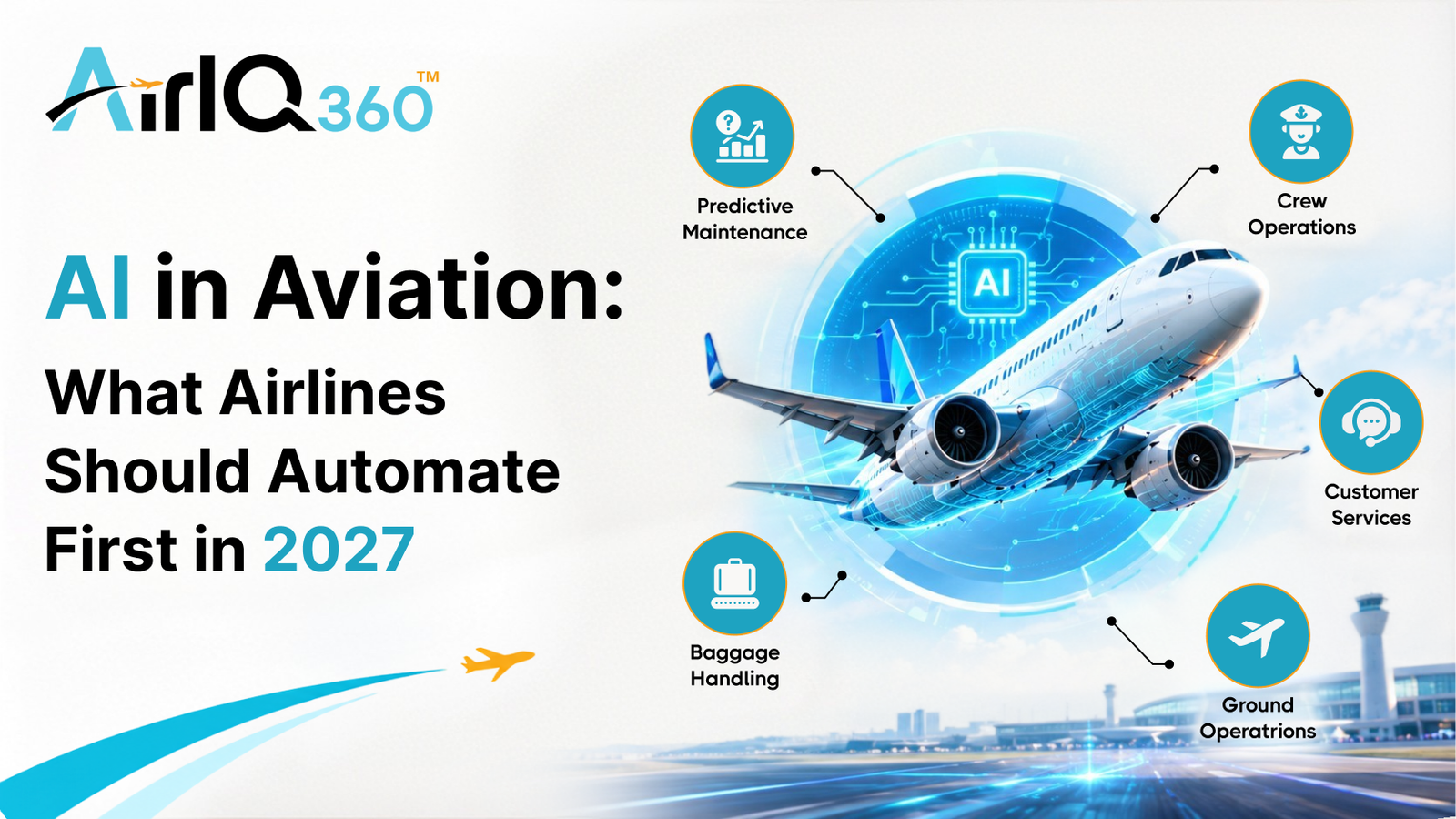
Every airline executive has heard the pitch by now. AI will cut costs, fix delays, delight passengers, and maybe even make coffee in the galley. The problem isn't whether AI in aviation works. It's knowing where to start when your budget, your data, and your team's patience are all limited.
After two years of pilots, proofs of concept, and a lot of vendor demos, 2027 is shaping up as the year airlines move from experimenting to scaling. So the real question is simple: what should you automate first?
This guide ranks the airline processes that deliver the fastest return with the lowest risk, explains why each one belongs on your roadmap, and flags the areas you should leave alone for now.
What Should Airlines Automate First?
Airlines should automate these five areas first in 2027:
- Predictive maintenance to reduce unscheduled groundings and AOG events
- Disruption management and passenger recommendation to recover faster from irregular operations
- Customer service and rebooking through AI agents that handle routine requests
- Crew scheduling and recovery to cut costly reassignments and legality errors
- Fuel and flight planning optimization to lower burn and emissions on every sector
These areas share three traits. They rely on data airlines already collect, they keep humans in control of final decisions, and they produce savings you can measure within months rather than years.
Why 2027 Is the Tipping Point for AI in Aviation
A few things have changed that make 2027 different from the years before it.
Regulators have given clearer direction. Both EASA's Artificial Intelligence Roadmap and the FAA's work on AI safety assurance have laid out how authorities think about machine learning in aviation. That doesn't mean autonomous cockpits are coming soon, but it does mean ground operations and decision support tools now have a clearer path to approval.
Generative AI matured quickly. Large language models went from novelty chatbots to tools that can read maintenance logs, summarize technical manuals, and draft passenger communications that actually sound human.
Airline data got better. Years of investment in cloud platforms, connected aircraft, and modern passenger service systems mean many carriers finally have clean, accessible data to feed AI models. If you're still working on that foundation.
Margins stayed thin. Fuel prices, labor costs, and supply chain problems with engines and parts haven't gone away. Airlines need efficiency gains, and they need them fast.
AI is no longer just for the biggest carriers. For years, advanced airline automation was something only large network airlines could afford. That's changing as more airline specific AI tools reach the market at a price and complexity midsize carriers can realistically handle.
How to Decide What to Automate First
Before jumping into the list, it helps to have a simple filter. We recommend scoring every possible AI use case on four questions:
| Criteria | What to Ask |
|---|---|
| Business value | Will this save real money or protect revenue within 12 months? |
| Data readiness | Do we already collect clean, reliable data for this process? |
| Safety and regulatory risk | Does this touch safety critical decisions that need certification? |
| Human in the loop | Can a trained person review and override the AI's output? |
The best first projects score high on value and data readiness, and low on regulatory risk. That's exactly why the list below focuses on operations and customer experience rather than the flight deck.
1. Predictive Maintenance: The Clearest ROI in Airline Automation
If you only automate one thing in 2027, make it predictive maintenance in aviation.
Modern aircraft generate enormous volumes of sensor data from engines, APUs, landing gear, and avionics. Most of that data used to sit unused until something broke. Machine learning models can now spot patterns that signal a component is starting to degrade, often weeks before it fails.
Why it belongs at the top of the list
- AOG events are expensive. An aircraft on ground means cancelled flights, stranded passengers, and emergency parts shipping. Preventing even a handful each year pays for the program.
- Parts shortages make planning critical. With engine and component supply chains still strained, knowing what you'll need weeks ahead is a competitive advantage.
- Engineers stay in charge. The AI flags risks, but licensed engineers make every maintenance decision. That keeps regulatory risk low.
What to automate specifically
Start with component health monitoring for high failure items, automated analysis of pilot and technician logbook entries, and smart parts forecasting tied to your MRO inventory. Generative AI tools are also proving useful for searching thousands of pages of maintenance manuals in seconds.
2. Disruption Management: Where AI Saves the Most Stress
Irregular operations are where airlines lose the most money and the most goodwill in the shortest time. A single thunderstorm at a hub can ripple through hundreds of flights, thousands of passengers, and dozens of crew pairings.
Airline disruption management is a perfect job for AI because it's a massive optimization problem with countless moving parts. Humans in the operations control center are brilliant, but no team can evaluate thousands of recovery options in a few minutes. Algorithms can.
What AI does well here
- Recommending aircraft swaps and tail reassignments that minimize knock on delays
- Predicting which flights are most likely to be disrupted hours before it happens
- Automatically reaccommodating passengers based on connection risk, loyalty tier, and seat availability
- Sending proactive rebooking offers to passengers before they even reach the gate
The human element
Keep your operations controllers in the driver's seat. The goal is decision support, not autopilot. Give your team ranked recovery scenarios with clear cost and passenger impact, and let them choose.
3. Customer Service and Rebooking: The Fastest Win Passengers Will Notice
AI in airline customer service has moved well beyond the frustrating chatbots of a few years ago. Today's AI agents can understand natural questions, access booking records, process changes, and hand off to a human agent when things get complicated.
Where to start
Focus on the high volume, low complexity requests that clog your contact centers:
- Flight status and delay updates
- Seat changes and upgrade requests
- Baggage allowance questions
- Voluntary rebooking and same day changes
- Refund and voucher status checks
- Compensation claims under passenger rights rules like EU261
Why it's a priority for 2027
When disruptions hit, call wait times explode. An AI agent that can handle rebooking at scale keeps passengers informed and frees your human agents for the cases that genuinely need empathy and judgment, like a family with a medical emergency or a passenger who missed a connection to a funeral.
One tip from carriers that have done this well: always make it easy to reach a real person. Passengers forgive automation when it's fast and helpful. They don't forgive being trapped in a loop. If your airline already runs its customer data on a CRM like Salesforce, building AI service on top of that data is usually faster than starting fresh.
4. AI Crew Scheduling and Recovery
Crew costs are among the biggest expenses any airline carries, and scheduling them is fiendishly complex. Duty time limits, rest requirements, union agreements, qualifications, base assignments, and personal preferences all have to fit together.
AI crew scheduling tools can build better pairings and rosters from the start, and more importantly, they can repair broken schedules quickly during disruptions.
Benefits airlines are seeing
- Fewer reserve crew callouts and less overtime
- Faster legality checks when schedules change
- Better quality of life for crew through preference based bidding
- Reduced risk of cancellations caused by crew timing out
Crew satisfaction matters more than ever given ongoing pilot and cabin crew shortages in many markets. A scheduling system that respects preferences can help with retention too.
5. Fuel Efficiency and Flight Planning Optimization
Fuel remains one of the largest line items for every airline. Even small percentage savings add up to serious money across a fleet over a year, and they also cut carbon emissions.
What to automate
- Dynamic flight planning that factors in real time winds, weather, and airspace restrictions
- Fuel loading recommendations based on historical burn data for each route and tail
- Single engine taxi and APU usage guidance to reduce ground fuel burn
- Cost index optimization that balances fuel cost against time related costs
Pilots and dispatchers keep final authority, which keeps this in the low risk category. It also supports your sustainability goals and reporting obligations.
Honorable Mentions: Strong Second Wave Candidates
Once your first projects are running, these areas deserve a close look:
Revenue management and dynamic pricing. AI can personalize offers and improve forecasting, especially as airlines move toward modern retailing with NDC and offer and order systems. It's high value but often requires bigger changes to your commercial systems.
Baggage handling and tracking. Computer vision and predictive models can flag bags at risk of missing connections, which cuts mishandled baggage costs.
Turnaround monitoring. Cameras at the gate paired with AI can track catering, fueling, cleaning, and boarding in real time, helping ground teams spot delays before they cause a late departure.
Back office automation. Invoice processing, interline revenue accounting, and fraud detection are unglamorous but offer steady, low risk savings.
What Airlines Should Not Automate First
Knowing what to avoid is just as valuable as knowing where to start.
Safety critical flight deck decisions. Certification for AI in the cockpit is still years away, and the regulatory path is long and expensive. Keep AI in an advisory role here.
Anything without clean data. If your data is scattered across legacy systems with no single source of truth, fix that first. An AI model built on bad data will make confident, wrong decisions.
Processes you don't fully understand. Automating a broken process just makes it break faster. Map and fix the workflow before adding AI.
Fully autonomous passenger interactions for sensitive cases. Complaints about injuries, discrimination, or bereavement need human care, full stop.
Build or Buy? A Note for Midsize Airlines
Large network carriers can afford in house data science teams and multiyear AI programs. Most regional and midsize airlines can't, and they don't need to. For them, an airline focused platform is usually the faster and lower risk route, since it already understands things like fare rules, reaccommodation, and loyalty tiers.
That's the gap AirIQ360 was created to fill. Developed by Plumlogix, a Salesforce partner with a long history in enterprise AI, it gives midsize carriers purpose built airline AI they can realistically afford and deploy, while keeping staff in control of the final decisions.
Whichever route you choose, judge any tool against the same four criteria from earlier: value, data readiness, risk, and human oversight.
Building Your 2027 AI Roadmap: A Practical Plan
Here's a simple sequence that works for most carriers, whether you're a regional operator or a global network airline.
Phase one (first quarter): Audit your data. Pick one operational use case, usually predictive maintenance, and one customer facing use case, usually AI rebooking. Set clear success metrics.
Phase two (second quarter): Run controlled pilots on a single fleet type or a single hub. Keep humans reviewing every AI recommendation. Track results weekly.
Phase three (second half of the year): Scale what worked. Retire what didn't. Add disruption management and crew recovery once your teams trust the tools.
Throughout the year: Invest in training. The biggest barrier to airline digital transformation usually isn't technology. It's people who don't trust or understand the new tools. Bring frontline staff into the process early.
The Bottom Line
AI in aviation isn't about replacing pilots, engineers, or agents. It's about giving them better information, faster, so they can make smarter decisions. The airlines that win in 2027 won't be the ones with the flashiest AI announcements. They'll be the ones that picked the right first projects, proved the value, and scaled carefully.
Start with predictive maintenance and disruption recovery. Add AI powered customer service. Then expand into crew, fuel, and commercial systems as your data and confidence grow. If you're a midsize carrier weighing where to begin, the AirIQ360 team is happy to talk through your options.
Frequently Asked Questions
What is AI in aviation used for?
AI in aviation is used for predictive maintenance, flight planning, fuel optimization, crew scheduling, disruption management, customer service, baggage tracking, revenue management, and air traffic flow forecasting. Most current uses support human decision makers rather than replacing them.
What should airlines automate first with AI?
Airlines should start with predictive maintenance and disruption management because they offer high returns, use data airlines already have, and keep trained professionals in control of final decisions. Customer service rebooking is the best first passenger facing project.
Is AI safe to use in airline operations?
Yes, when it's used for decision support with human oversight. Regulators like EASA and the FAA have published guidance on AI assurance, and most ground and operational uses carry far lower risk than cockpit applications, which still face strict certification requirements.
How does predictive maintenance save airlines money?
Predictive maintenance uses sensor data and machine learning to detect component wear before failure. This reduces unscheduled groundings, cuts emergency parts costs, improves aircraft availability, and prevents flight cancellations.
Can midsize airlines afford AI?
Yes. Midsize carriers don't need to build AI from scratch. Airline focused platforms such as AirIQ360™ are designed to give smaller and midsize airlines enterprise grade capabilities at a cost and timeline they can manage.
Will AI replace airline jobs?
AI is more likely to change airline jobs than eliminate them. It handles repetitive tasks like routine rebooking and data analysis, which frees staff to focus on complex problems, safety, and passenger care. Many airlines are also using AI to ease pressure caused by staff shortages.
How long does it take to see ROI from airline AI?
Well scoped projects like predictive maintenance or AI customer service often show measurable results within six to twelve months. Larger programs involving revenue management or full operations control take longer.